
Class A:
Class A airspace is designed to separate high flying, fast moving, and far traveling aircraft from lower level, arrival and departure phases as well as slower general aviation aircraft. Aircraft in this airspace are exclusively in their enroute or “cruise” phase of flight. If victor airways are the highways in the sky, you can think of routes in class A airspace as the express lanes or toll roads of the system, as there are more requirements to get in, but once you’re in, there’s a much lower traffic density and not as much “merging” for air traffic control to coordinate.
§ 71.33 Class A airspace areas.
(a) That airspace of the United States, including that airspace overlying the waters within 12 nautical miles of the coast of the 48 contiguous States, from 18,000 feet MSL to and including FL600 excluding the states of Alaska and Hawaii.
(b) That airspace of the State of Alaska, including that airspace overlying the waters within 12 nautical miles of the coast, from 18,000 feet MSL to and including FL600 but not including the airspace less than 1,500 feet above the surface of the earth and the Alaska Peninsula west of longitude 160°00′00″ West.
(c) The airspace areas listed as offshore airspace areas in subpart A of FAA Order JO 7400.11K (incorporated by reference, see § 71.1) that are designated in international airspace within areas of domestic radio navigational signal or ATC radar coverage, and within which domestic ATC procedures are applied.
Where is class A airspace?
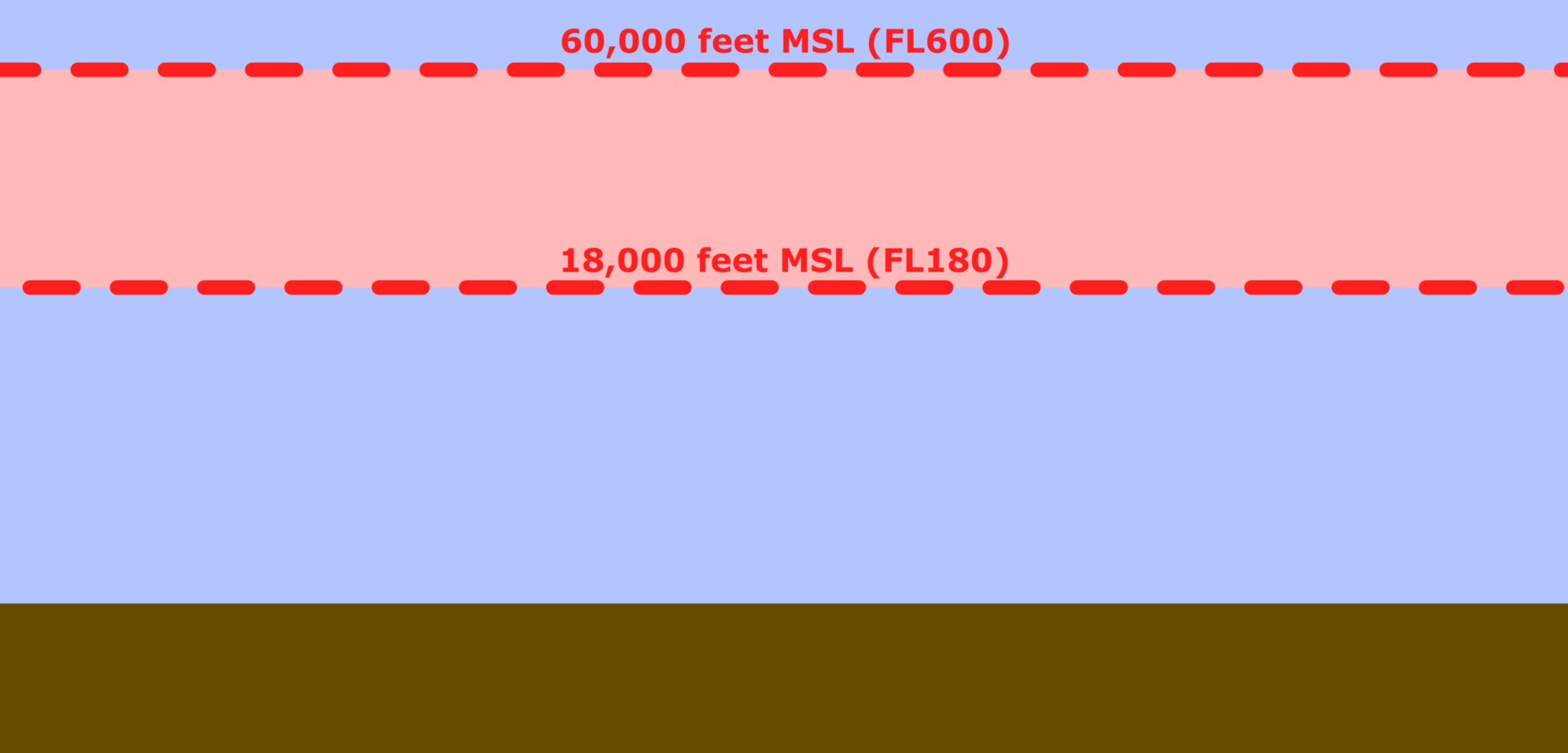
FAR 71.33 is the regulation that specifies where class A airspace is located.
Lateral boundaries: Within 12 nautical miles of the coast of the 48 contiguous States and Alaska
Altitude: From 18,000 feet MSL (FL180) to 60,000 feet MSL (FL600)
Exceptions: Class A airspace can extend farther than 12 nautical miles from the coast if there is radar coverage or NAVAID signal AND a domestic ATC procedure applies. In Alaska class A airspace is not present below 1500 feet AGL or west of longitude 160°W
Class A airspace isn’t depicted on your VFR charts for multiple reasons. First, the airspace is much too high to matter for most general aviation flights that are using VFR charts. Second, class A airspace has a very consistent definition in the 48 contiguous states and doesn’t change altitudes at all, so a depiction is unnecessary. Lastly, the airspace is IFR only so it wouldn’t make sense to depict it on a VFR chart.
Note:
At and above 18,000 feet MSL we refer to altitudes as flight levels. We also change the way they are written and said. For example, 21,000 feet MSL would be written as FL210 and referred to as flight level 2-1-0
§ 91.135 Operations in Class A airspace.
Except as provided in paragraph (d) of this section, each person operating an aircraft in Class A airspace must conduct that operation under instrument flight rules (IFR) and in compliance with the following:
(a) Clearance. Operations may be conducted only under an ATC clearance received prior to entering the airspace.
(b) Communications. Unless otherwise authorized by ATC, each aircraft operating in Class A airspace must be equipped with a two-way radio capable of communicating with ATC on a frequency assigned by ATC. Each pilot must maintain two-way radio communications with ATC while operating in Class A airspace.
(c) Equipment requirements. Unless otherwise authorized by ATC, no person may operate an aircraft within Class A airspace unless that aircraft is equipped with the applicable equipment specified in § 91.215, and after January 1, 2020, § 91.225.
(d) ATC authorizations. An operator may deviate from any provision of this section under the provisions of an ATC authorization issued by the ATC facility having jurisdiction of the airspace concerned. In the case of an inoperative transponder, ATC may immediately approve an operation within a Class A airspace area allowing flight to continue, if desired, to the airport of ultimate destination, including any intermediate stops, or to proceed to a place where suitable repairs can be made, or both. Requests for deviation from any provision of this section must be submitted in writing, at least 4 days before the proposed operation. ATC may authorize a deviation on a continuing basis or for an individual flight.
How do I get into class A airspace?
Like with all airspace, class A airspace has equipment, communication, and clearance requirements. These requirements are dictated by FAR 91.135.
Clearance: From paragraph (a) we can see that a clearance, specifically an IFR clearance is required prior to entering the class A airspace. This means that VFR flight is prohibited.
Communication: Paragraph (b) states that aircraft operating in class A airspace must have a two way radio and be in communication with air traffic control on the appropriate assigned frequency at all times.
Equipment: Paragraph (c) describes that we need a Transponder with mode C (altitude reporting) capabilities (91.215), and ADS-B out equipment (91.225). However, we also know that operating under IFR is also a requirement from paragraph (a) so we can imply that the aircraft must have the equipment specified in 91.205 for IFR operations. We can also add a two way radio to the list since that is specified in paragraph (b)
Paragraph (d) discusses exceptions to the rules in the above paragraphs due to malfunctioning or inoperative equipment. We won’t read too much into this since we plan to fly with operative equipment, but there are rules in place to allow for type type of flight.